Grain sorption isotherms: understanding the RH and water content equilibrium
A grain sorption isotherm describes the thermodynamic relationship between the moisture content of a cereal, pulse, or oilseed and the relative humidity (RH) of the surrounding air atmosphere when the system is in a state of equilibrium. At any specific constant temperature, a plot of this relationship yields the isotherm curve.
Understanding these curves is foundational in food science, engineering, and product preservation, as the equilibrium point between the solid phase (grain) and the gas phase (air) determines product stability and thermodynamic behavior during processing or storage.
The chart provided illustrates the adsorption isotherms (curves representing moisture gain) for several economically significant crops: French Wheat, USA Maize, English Maize, Barley, Soybean (seeds), Sunflower (seeds), and Peanut. This data is derived from the work of Pixture & Warburton and Multon.
Fundamental Parameters
The provided graph plots two essential variables, defining the axes of measurement for these thermodynamic relationships:
Equilibrium Moisture Content (EMC) (% d.b.)
The vertical Y-axis measures the Equilibrium Moisture Content (EMC). EMC is the quantity of water held within the solid structure of the grain when it is in thermodynamic equilibrium with the surrounding environment.
On this chart, EMC is expressed as a percentage on a Dry Basis (% d.b.). This is calculated by comparing the weight of the water to the weight of the completely dry solid material.
Formula: (Weight of Water / Weight of Dry Solids) × 100%
Note: Dry basis is preferred in scientific and engineering contexts, particularly for analyzing drying kinetics, as the weight of the dry solids remains constant, whereas the "wet basis" percentage changes as water is added or removed.
Equilibrium Relative Humidity (ERH) (= Aw %)
The horizontal X-axis measures the Equilibrium Relative Humidity (ERH) of the air mass immediately surrounding the bulk grain.
The relationship shown on this axis is the core concept of moisture sorption: Aw = ERH / 100
Therefore, an ERH of 70% is thermodynamically equivalent to a Water Activity of 0.70. While moisture content (EMC) measures the total volume of water, Water Activity (Aw) measures the thermodynamic energy state of that water. It describes the availability of water to participate in chemical reactions, physical changes, or biological processes.
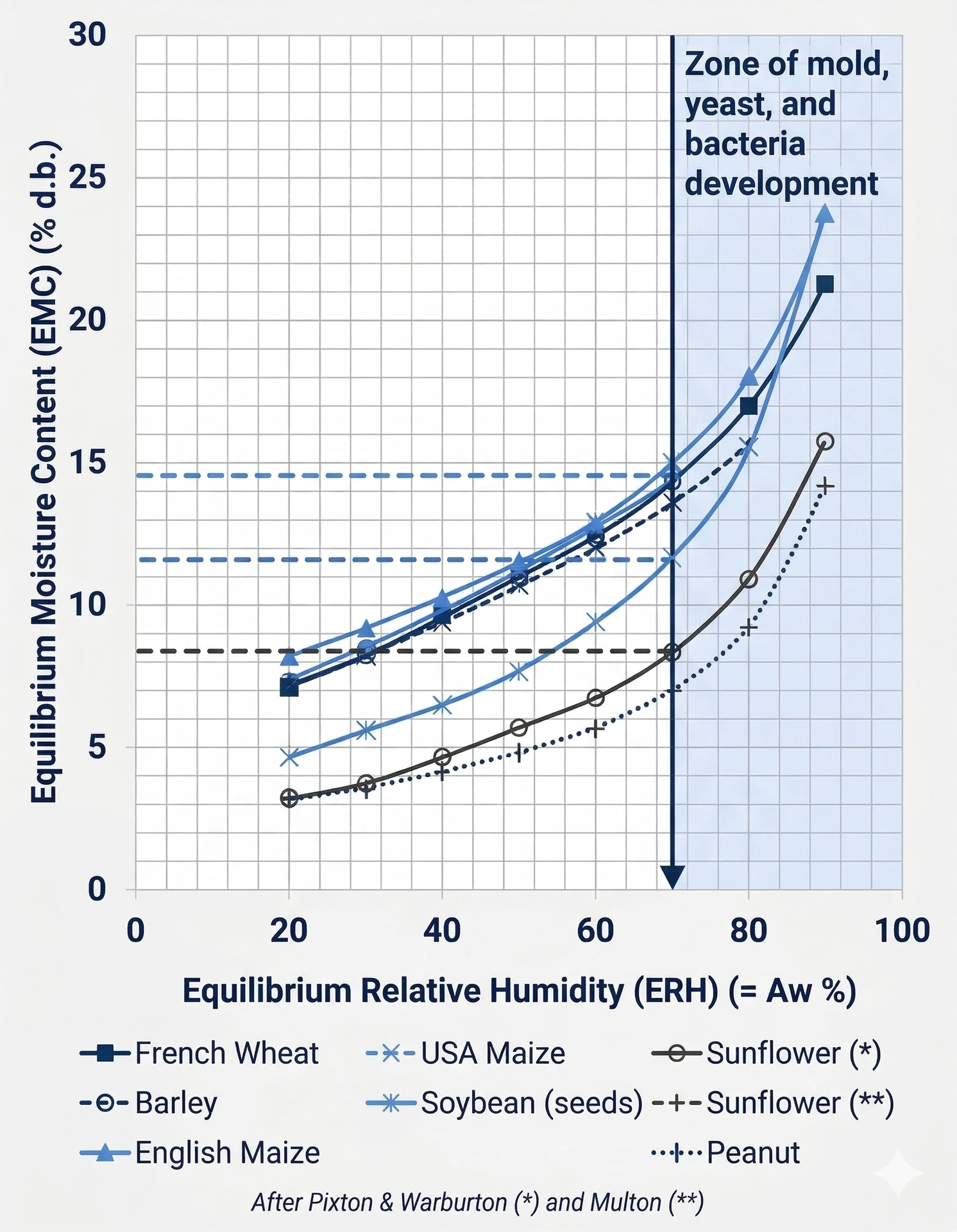 Correspondence curves between water activity in the grain (at equilibrium with air humidity between grains = grain mass hygrometry) and water content measured at 20°C (equilibrium varies slightly with temperature).
Microbial Development Threshold and Risk Assessment
The chart includes a shaded vertical region beginning at 70% ERH (0.70 Aw), marked clearly as the Zone of mold, yeast, and bacteria development.
This 70% threshold is recognized in biology and food microbiology as the critical tipping point for product preservation.
Aw < 0.70 (Safe Zone): The majority of the water is tightly bound at the molecular level within the grain structure. The remaining "free" water activity is too low to sustain the life cycle of spoilage microorganisms.
Aw > 0.70 (Development Zone): Water becomes sufficiently "free" and available to support cellular respiration and reproduction.
As indicated by the text overlay, biological deterioration proceeds sequentially as the available water activity increases further:
Molds (moisissures): Generally require a minimum water activity of approximately 0.70–0.75 to activate and proliferate.
Yeasts (levures): Typically activate around Aw 0.80.
Bacteria (bactéries): Require the highest level of free moisture, generally above Aw 0.85.
Microbial proliferation is accompanied by significant respiration (generating heat and water), localized nutrient loss, physical breakdown of the grain, and, most critically, the production of secondary toxic metabolites (mycotoxins) which render the product unusable.
Composition Effects: Starchy Grains vs. High-Oil Seeds
A key scientific principle illustrated by the distinct separation of the curves is that the commodity’s chemical composition dictates its moisture sorption behavior. The interaction between crop type and available moisture is defined by the hydrophilic (water-attracting) or hydrophobic (water-repelling) nature of its constituents.
Cereal and Starch-Rich Crops (Hygroscopic Tendency)
Cereal grains (such as French Wheat, Barley, and Maize) have curves grouped in the upper portion of the chart.
These crops are high in carbohydrate (starch) content. Starch is a highly hygroscopic polymer, meaning it has numerous active sites that bind readily with water molecules through hydrogen bonding. As a result, at the same surrounding environmental humidity, starchy grains will inevitably absorb and maintain a higher total water percentage (EMC) than high-oil seeds.
Example: Examining the 60% Relative Humidity line, Wheat and Maize settle at an EMC of approximately 12.5–14.5%.
Oilseeds and Lipid-Rich Crops (Hydrophobic Tendency)
High-oil crops (such as Sunflower seeds and Peanuts) have curves grouped much lower on the chart.
These seeds contain a high percentage of lipids (oil). Lipids are fundamentally hydrophobic—they repel water. The presence of oil effectively displaces potential water storage sites within the seed structure. Therefore, at the exact same environmental humidity, oilseeds reach a much lower equilibrium moisture percentage.
Example: Locate the 60% Relative Humidity line again. Following this line to the curves for Sunflower seeds, the established EMC is much lower, approximately 6.5–8%. Peanuts are even lower, near 6%.
Summary of Differences by Composition
This phenomenon means you cannot define safe moisture targets solely by percentage content; you must define them by composition and the targeted water activity. To ensure conditions remain below the 70% Aw microbial risk threshold, different grains must be dried to significantly different final moisture percentages.