How CO₂ modified atmosphere preserves seed germination capacity long-term
The oxygen deprivation caused by partial vacuuming or the replacement of air in hermetic enclosures with dinitrogen, CO₂ or a mixture of the two inert gases, has the effect of prolonging the longevity (viability) of seeds. Numerous published studies on the long-term storage of oilseeds and protein crops (such as soybeans) have shown that there is a significant advantage to storing in a rarefied oxygen atmosphere, either under vacuum, or by replacing the air with inert gases, even partially.
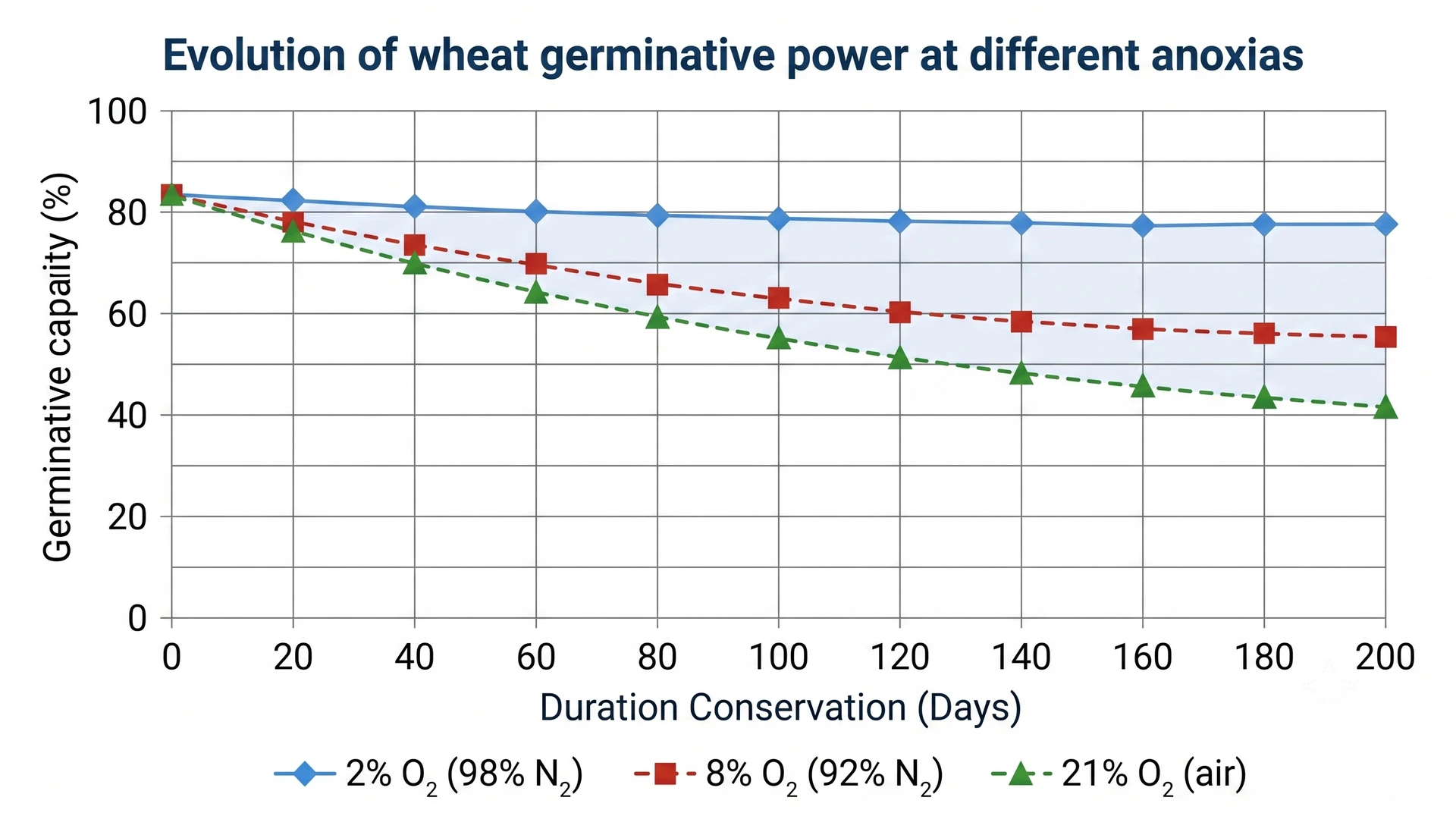
Storage in an oxygen-reduced atmosphere shows that the higher the residual oxygen content,
the greater the impact on germination capacity (data taken from Iconomou et al, 2019).
If, in addition to oxygen depletion, carbon dioxide (CO₂) is added, the beneficial effect is even more pronounced, whatever the residual oxygen content, provided that the CO₂ content is greater than or equal to 50%.
Pulses (chickpeas)
Storage in CO₂ atmospheres at over 50% air concentration significantly prolongs seed viability, even when seed temperatures exceed recommended limits to limit the degrading effect of high temperatures.
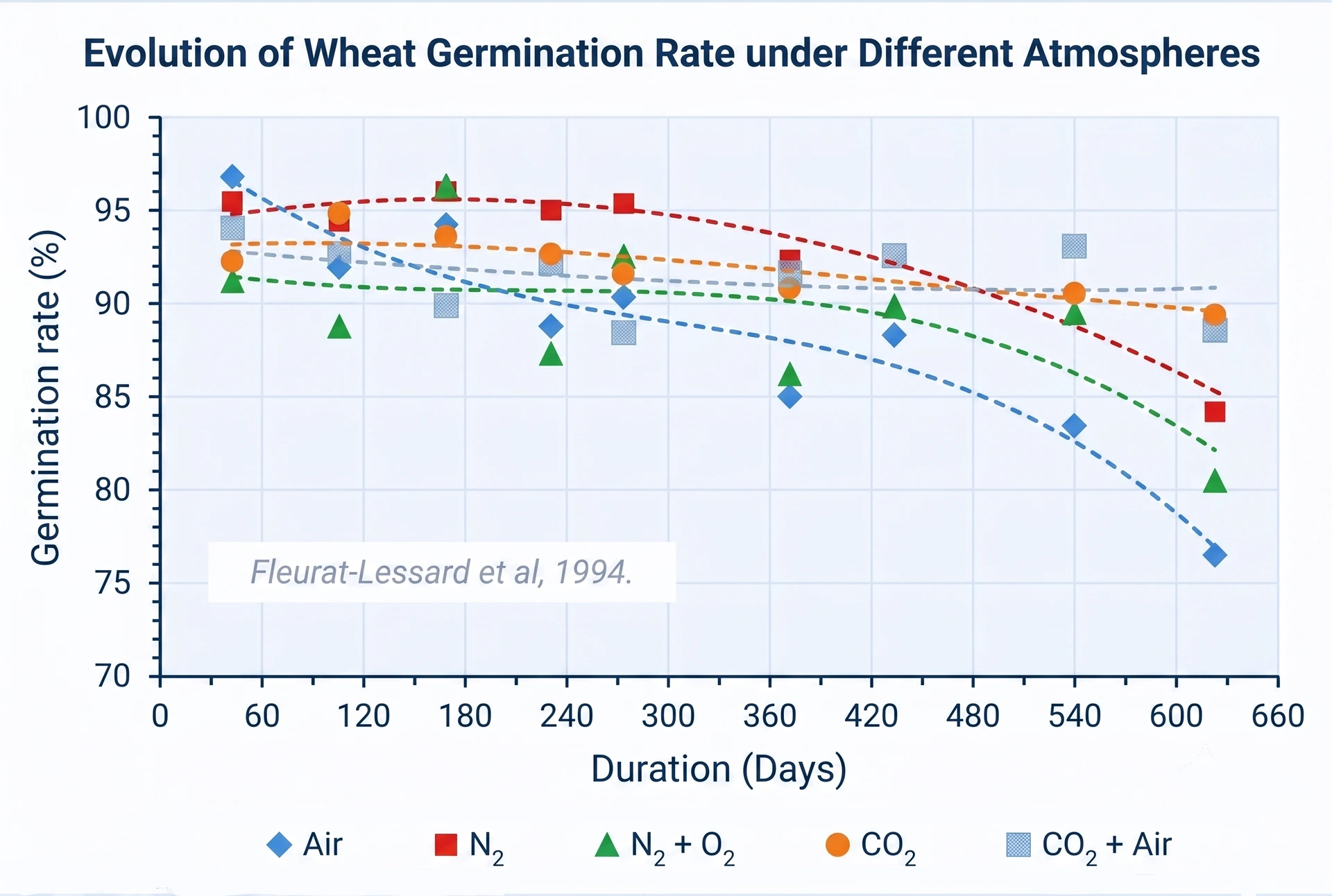
Evolution curves over 20 months for the germination capacity (G.P.) of a French wheat variety stored at 15°C under different modified atmospheres (MA)
or normal atmosphere (air): AM with CO₂ gave the best results (5% drop vs. 20% drop in normal atmosphere).
For example, after 6 months' storage of chickpeas in hermetically sealed containers under 50% CO₂, the germination percentage remained at 89.2%, compared with 74.5% when stored in the open air.
Rice (and similar cereals)
By storing rice in a 50% CO₂ atmosphere at elevated temperature for 45 days, germination capacity is maintained at 95-97% depending on variety, compared with 79-81% when stored in the open air. The effect on the germination vigor index is even more significant: the index drops to 83-94% of its initial value under CO₂, whereas it falls to 60-67% of its initial value in the open air (under the effect of the high temperature).
Soy
Thus, for soybeans stored at room temperature (fluctuating seasonally between a minimum of 14.5°C and a maximum of 35.7°C), when kept in the open air, germination capacity falls from 95.3% to just 19.4% after one year's storage. When stored under the same temperature conditions in hermetically sealed containers in an atmosphere with a CO₂/O₂/N₂ composition of 80/5/15%, it retains a germination capacity of 82.5% after one year. Under vacuum in a sealed polyethylene bag, germination is 81.2%, and under pure CO₂, 74.3%.
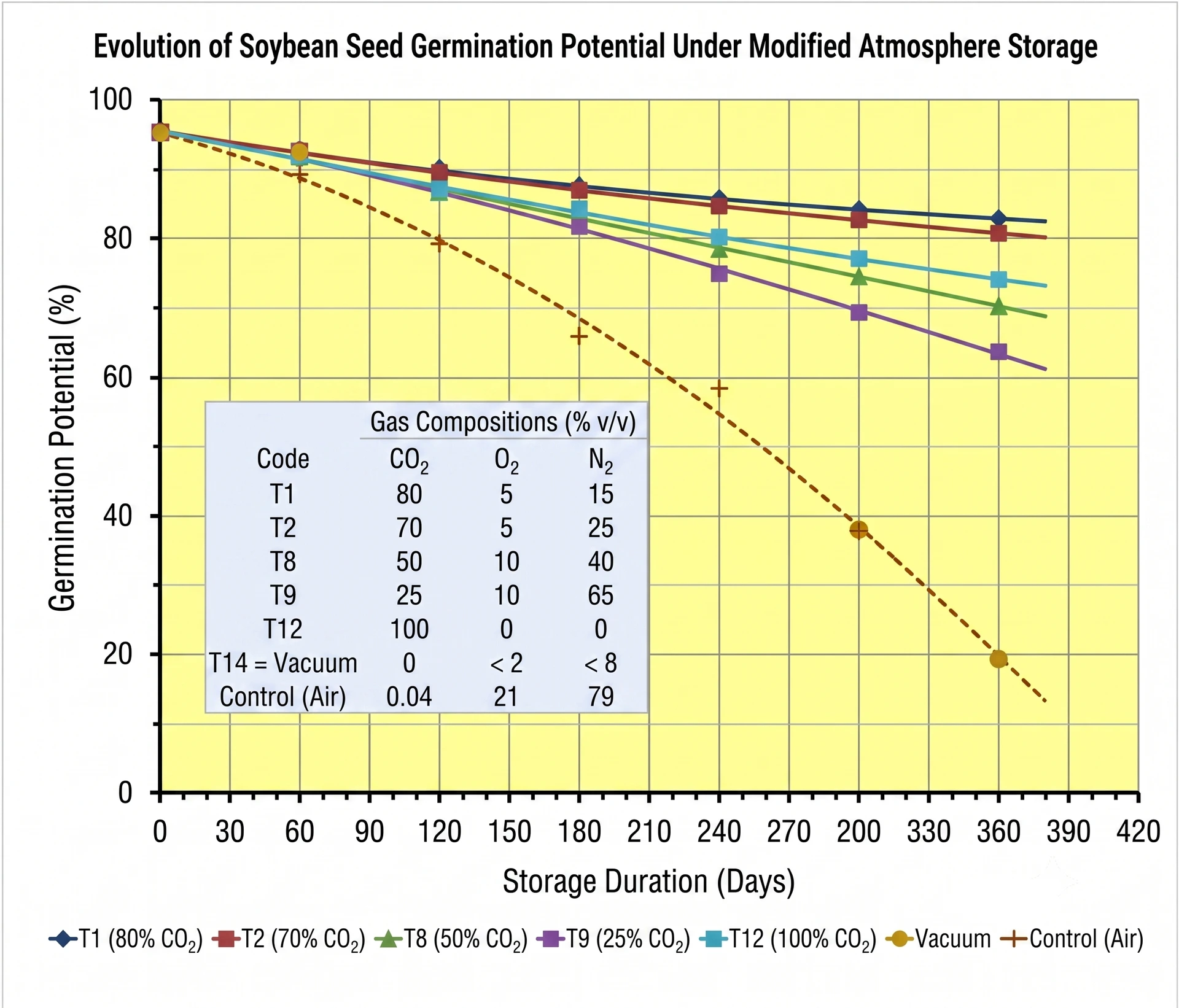
Reduction in natural germination degradation of soybean seeds by storage in a CO₂*-modified atmosphere (data from Swapna Kumari, 2013).*
If the storage temperature had not exceeded 22°C at the start of the (hottest) storage period, it is likely that germination capacity would have been fully preserved with the most "conservative" modified atmosphere composition: only 5% O₂ and 80% CO₂, the remainder nitrogen (15%). This advantage of inert gas conservation is particularly important for the long-term conservation of oilseed and protein crop seeds.
This advantage of conservation under CO₂-enriched atmosphere has been verified by other authors.