Critical humidity and temperature thresholds for safe seed storage
Decreased germination capacity is the grain property that deteriorates first under uncontrolled storage conditions. It is a good indicator of critical or poorly controlled storage conditions. When the Relative Humidity (RH) of the air between grains exceeds 70%, there is a risk of storage mold development, the main factor in seed germ deterioration. This critical RH corresponds to a water content limit for good preservation, which depends on the species and the storage temperature.
| Seeds | 5°C | 15°C | 22°C |
| Corn (Maize) | 15.80% | 15.10% | 14.60% |
| Sunflower (standard) | 8.25% | 7.75% | 7.25% |
| Sunflower (high-oil) | 7.00% | 6.50% | 6.00% |
| Rapeseed (Canola) | 9.90% | 8.80% | 8.40% |
| Soft wheat | 14.50% | 14.00% | 13.60% |
| Durum wheat | 14.10% | 13.60% | 13.20% |
| Malting barley | 13.90% | 13.40% | 13.00% |
| Lentils | 14.50% | 13.80% | 13.00% |
Preservation of seed germination capacity according to state of origin: water content limits not to be exceeded according to storage temperature.
Critical water content threshold
Grain moisture content is the most important factor in the deterioration of germination capacity. The effect of moisture on germinability is very strong, even at a moderate storage temperature of 20°C. When seeds are stored above the recommended humidity for long-term storage, the higher the moisture content at the start of storage, the more rapidly germinative capacity deteriorates. The "high storage temperature" effect is even more marked for germinative vigor than for germinative power.
Germinative energy is also the index most sensitive to the action of atmospheric oxygen on the seed germ, particularly in the case of oilseeds.
To preserve the germinative capacity of seeds over the long term (e.g. a whole year), the water content at storage must not exceed the critical water activity threshold of 0.70, corresponding to an upper limit water content of 14.5% for cereals and pulses (lentils, chickpeas, beans, broad beans), 11.5% for soya beans and only 8 to 9% for oilseeds (sunflower - rapeseed).
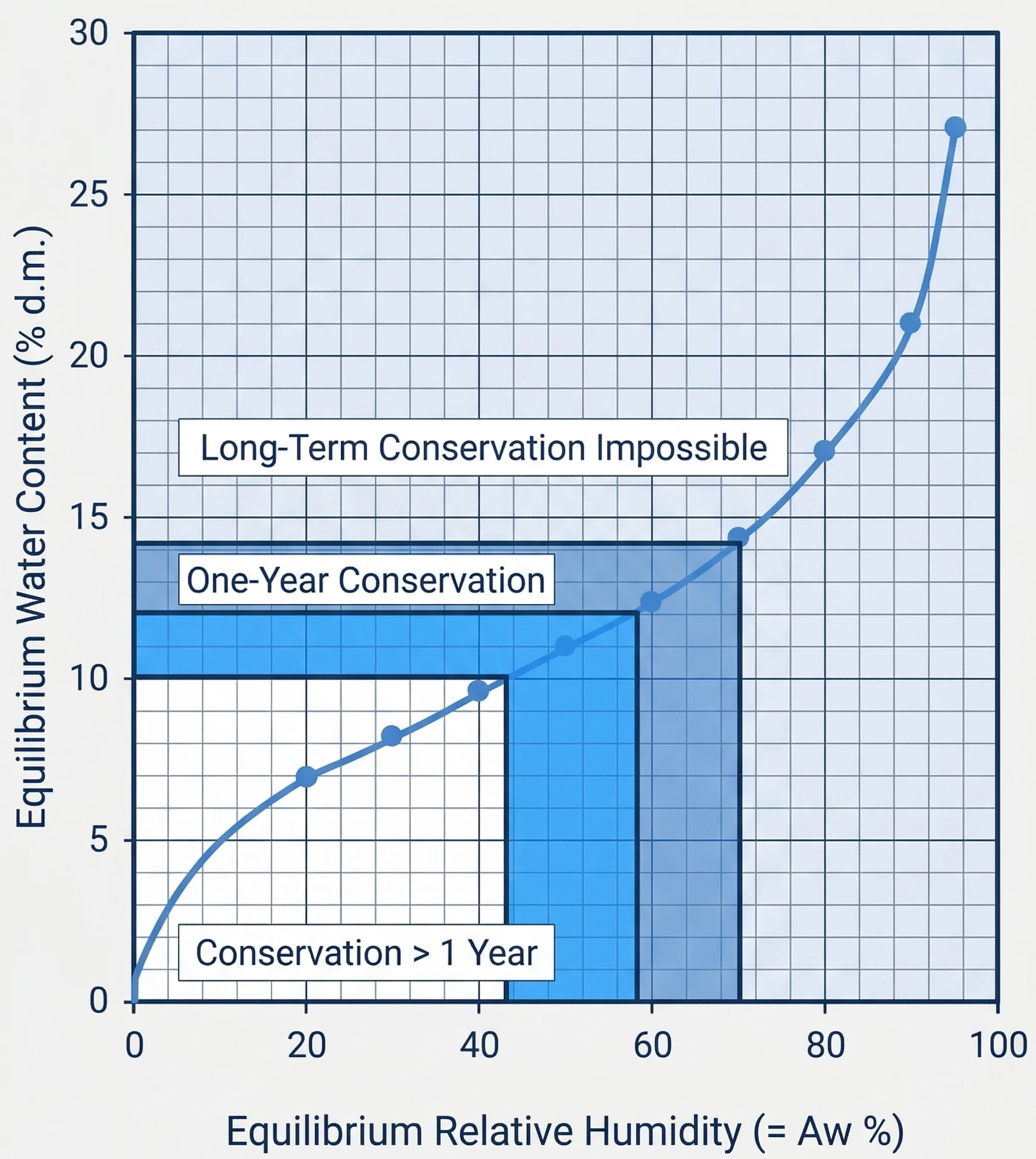
Moisture content limits for malting barley enabling germination capacity over the long term.
For example, for malting barley, the predicted shelf life of germination capacity can be determined from the sorption/desorption curve of grain water content.
When the moisture content of barley is between 12% and 14%, germination capacity will last a full year (without falling below 95%). Above 14% moisture content, germination capacity falls below 95% in less than a year.
The effect of humidity is very strong on germination capacity, and is felt even at a moderate storage temperature of 20°C, when seeds are kept above the recommended humidity for long-term storage. The higher the moisture content at the start of storage, the more rapidly germinative capacity deteriorates.
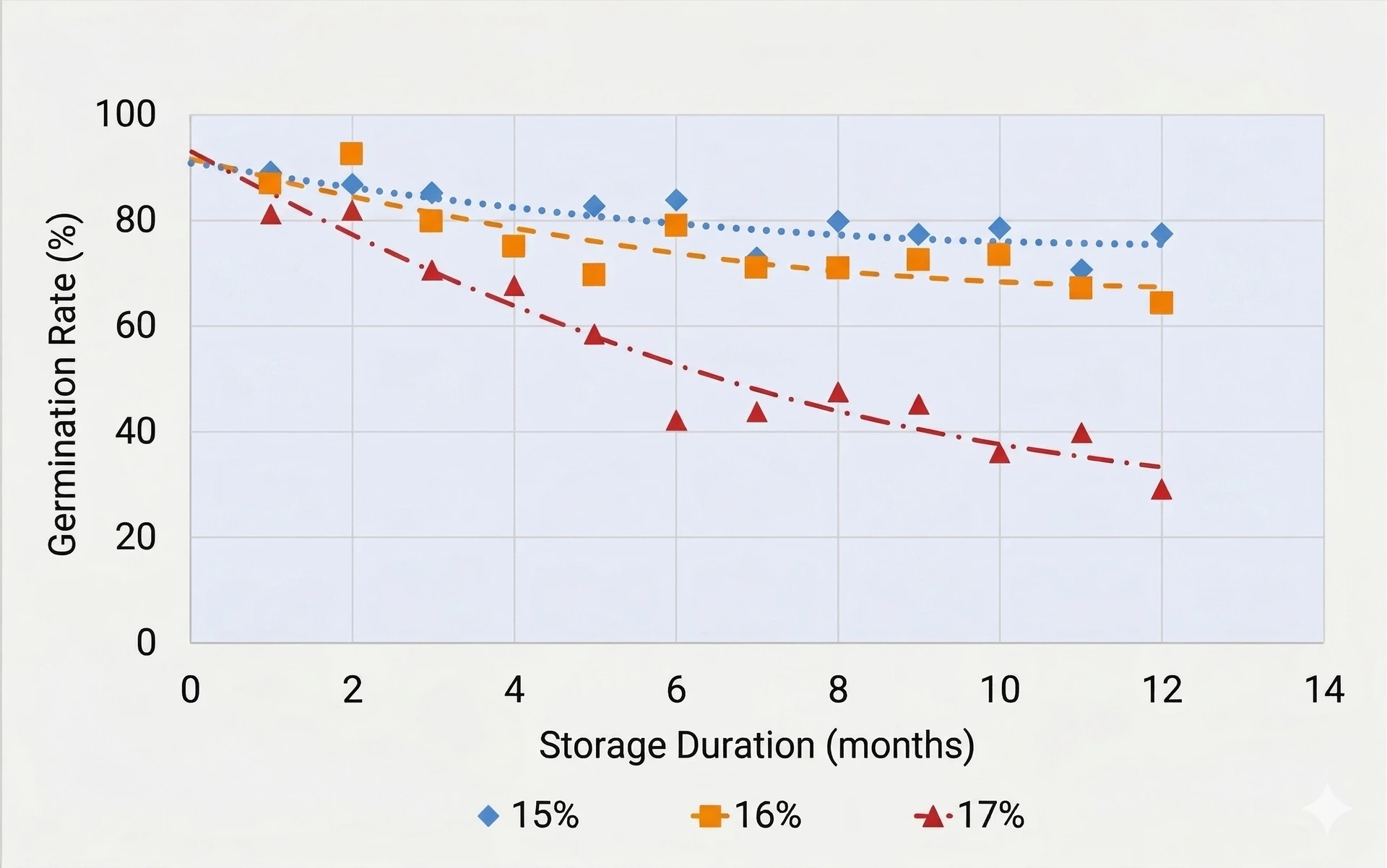
Influence of water content above the critical threshold for good preservation on the germination capacity of durum wheat at 20°C.
Critical temperature threshold
The temperature of the stored grain must also be taken into account for good preservation. Storage temperatures above 25°C have a detrimental effect on the germinative capacity and vigour of the grain. Cooling grains as soon as possible after harvest prevents the multiplication of "storage" insects, but is also recommended for seeds and cereals intended for malt production (malting barley and, to a lesser extent, wheat and rye).
To preserve the germinative capacity of seeds, the temperature must not exceed 20-22°C throughout the entire storage period, when storage is expected to last (one year or more). The detrimental effect of temperatures above 20-22°C and moisture contents of 15% or more (for cereals) or 9% or more (for oilseeds) on germination capacity is well documented. For example, at 30°C, the degradation of the germination capacity of dry wheat (at 12% moisture content) is very rapid compared to the relative stability when stored at 20°C.
Storing seeds at 20-22°C, in a well-insulated building, preserves germination capacity over the long term if water content is sufficiently low and provided there are no living insects at the time of entry into long-term storage and rodents cannot easily penetrate the interior.
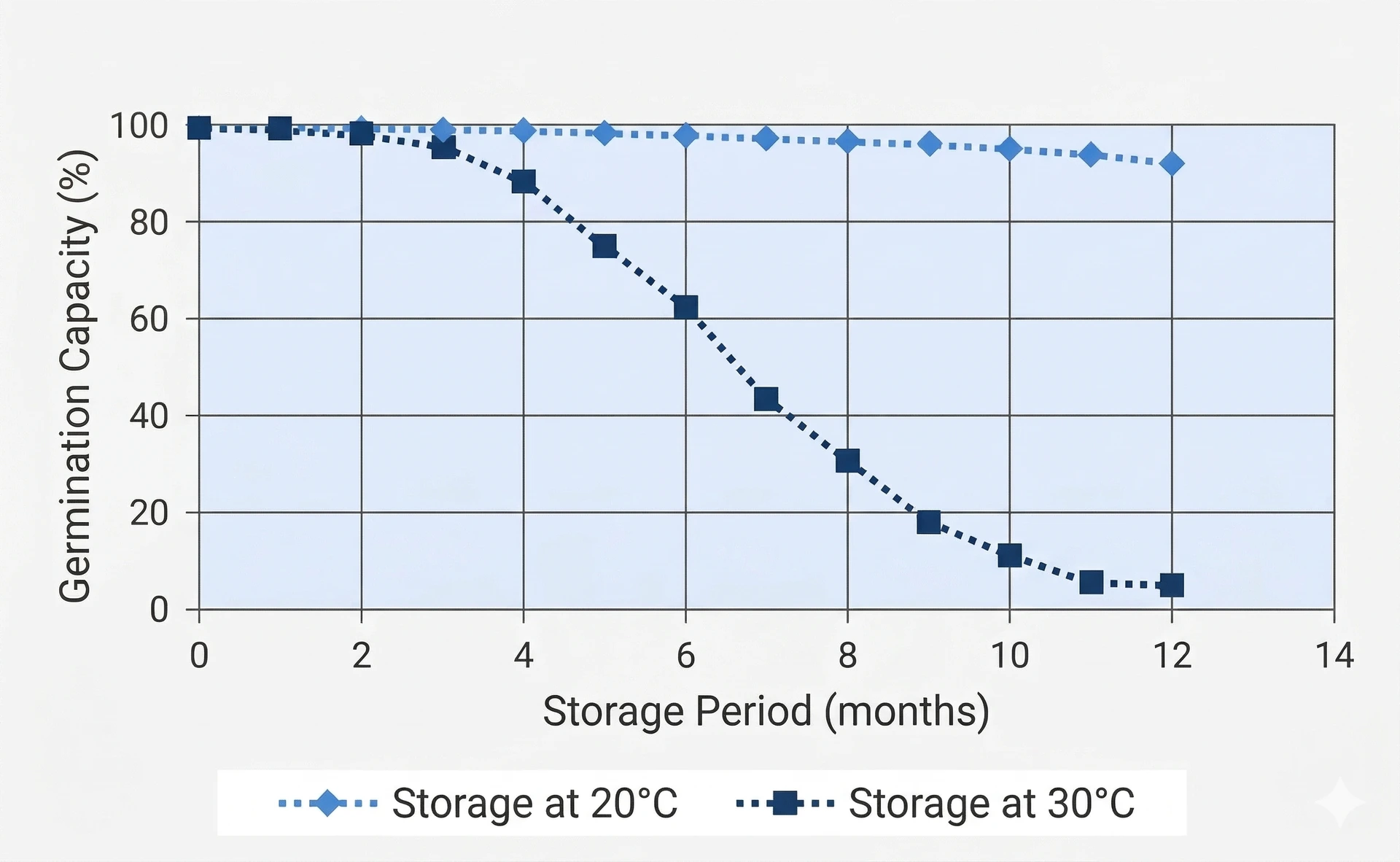
Evolution of germination capacity of wheat with only 12% moisture, stored at either 20°C or 30°C. Result: 50% loss of germination capacity in 6 months at 30°C (source CSIRO, Australia).