CO₂ vs nitrogen: using inert gas modified atmosphere for grain disinsectisation
Oxygen accounts for almost 21% of the composition of air. Carbon dioxide and dinitrogen are called inert gases, because they do not react chemically under natural conditions. The carbon dioxide content of air is around 0.4 per thousand (400 µL/L).
In all cases where rapid disinsectisation is required (batches of legumes infested with bruchids at harvest, seeds returned to the factory at the end of a sowing campaign, packaged carryover seeds to be saved for a future campaign (reconditioning) or prior to destruction, etc.), conditioning in cells, containers or containers is the best solution.), packaging in a cell, container or sealable flexible enclosure enables disinsectisation to be carried out by injecting an inert gas (pure dinitrogen or CO₂ at a concentration ≥ 60%) which will asphyxiate the insects if the inert atmosphere is maintained long enough under specific temperature conditions.
Nitrogen only acts on insects by asphyxiation, which requires complete replacement of the air in the hermetic enclosure to obtain a nitrogen concentration of over 95%, which must then be maintained at this level for exposure times of two to three weeks, depending on grain temperature.
Carbon dioxide (or "carbon dioxide") has a specific effect on insect cell respiration, inhibiting the production of ATP, the cell's "fuel" (Fleurat-Lessard, 1990), from a minimum air concentration of 40-45%. At CO₂ levels of 60% or more, insect survival time decreases rapidly, enabling us to optimize combinations of CO₂ level, temperature and lethal exposure time, depending on the condition of the grain to be disinsected. The sharp drop in oxygen content after CO₂ injection will limit lipid oxidation and slow seed aging, particularly in the case of oilseeds.
There are several inert-gas techniques: gas supply in pressurized gas cylinders (at 150 atmospheres); provision of a tank installed at the place of use; delivery by tanker truck; for CO₂, dry ice solution (at -80°C); for dinitrogen, production by an air dinitrogen exchanger and inert gases produced by gas burners (with low CO₂ content and less than 1% oxygen).
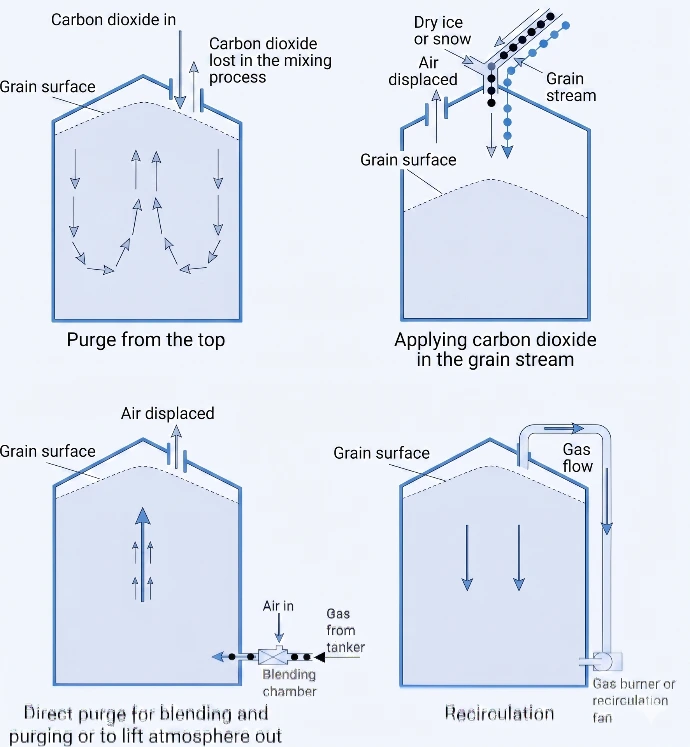
Different ways of using CO₂ to inert a cell or flexible storage enclosure (taken from Navarro, 2006).
Legend: 1 = injection of gas when the cell is loaded; 2 = deposition of dry ice as the cell is filled;
3 = injection of pressurized gas from the bottom of the cell; 4 = use of an inert gas generator with external recirculation system.
Not all these options are equivalent, but this choice of options means that inert gas preservation and disinsectisation techniques can be optimally adapted to user requirements. One of the most flexible solutions is that of sealable big-bags, into which CO₂ can be injected after creating a partial vacuum inside the enclosure (with a vacuum cleaner or vacuum pump), which is then sealed by an electric sealing clamp. The quantity of CO₂ to be injected is easily measured by simple weighing.
Diazote or carbon dioxide?
Exposure to inert gases requires a hermetically sealed storage enclosure.
These formats are being developed all over the world to ban the use of contact insecticides (which leave residues in processed products) or as an alternative to phosphine fumigation (due to the rise in insect resistance to this gas in countries which use it systematically: USA, Brazil, Australia, India, etc.).
With hermetically sealed storage, replacing fumigation by exposure to an inert gas (nitrogen or carbon dioxide), under the same conditions, is easy and frees us from some of the constraints associated with the use of phosphine, which currently put off producers of organic or label products (IGP, label rouge, CRC wheat, etc.), especially those with large volumes.), especially those with modest production volumes or who produce seeds, such as producers of organic legumes, lentils, broad beans, yellow peas, lupins, chickpeas and soybeans, crops which are booming in France.
The main advantages and disadvantages of inerting with nitrogen or carbon dioxide are listed in the table.
Gas type | Advantages | Disadvantages |
N₂ | Chemically inert in a storage environment | Longer insect elimination time below 25°C |
From a worker safety standpoint: no OEL* | Effective only at concentrations of 97% or more of volume in air | |
Less expensive by volume than CO₂ | Inevitable gas losses during long-term storage | |
Can be perfectly stored in large steel cylinders and high-pressure tanks | Handling of pressurised tanks requires safety systems for operators | |
CO₂ | Effective at concentrations ≥ 35% of volume in air | Soluble in water and moderately corrosive |
Below 25°C, insect elimination is faster than with N₂ | More hazardous, OEL of 5,000 ppm (0.5%) | |
Rapid elimination under high pressures (hyperbaric technique) | Precautions: do not open cylinders in confined spaces and ensure a detector is available (low-level detection, OEL compliance) | |
Can be perfectly stored in large steel cylinders and high-pressure tanks | Handling of pressurised tanks requires safety systems for operators |
*OEL = Occupational Exposure Limit. This is a value (in ppm in air) above which short-term exposure poses a risk to human health.